The theory of deficit value
Conserving capital under conditions of harmful abundance
Introduction
In an era when Marx’s classical surplus value has become pop, the theory of deficit value emerges as a brilliant innovation, a natural reaction to the reality of an oversaturated economy. It explains why the richest and most developed powers, drowning in wealth, voluntarily slow down growth, replacing exploitation with “repentance” through bureaucracy and redistribution.
- Problem: the richest powers are drowning in wealth.
- Solution: managed degradation as a way to keep the balance between innovation and survival.
The theory of surplus value
Basic terms
- $c$ — constant capital (machines, raw materials)
- $v$ — the worker’s wage
- $m$ — surplus value
Total capital: $c + v$
The rate of surplus value (measures the degree of exploitation):
$$m^{\prime} = \frac{m}{v} \times 100\%$$
The rate of profit:
$$P^{\prime} = \frac{m}{c+v} \times 100\%$$
The problem of $P^{\prime} → 0$
The capitalist tries to raise $P^{\prime}$. This can only be done by increasing surplus value. For that, more efficient means of labour have to be introduced, that is, $c$ has to grow (investing in machines). However, $m$ does not grow in proportion to the growth of $c$, which is why the rate of profit gradually tends to zero.
| Stage | Machines | Wages | Profit | Rate of profit |
|---|---|---|---|---|
| Start | 100 RUB | 100 RUB | 100 RUB | 50% (100/200) |
| After 5 years | 500 RUB (new machines) | 100 RUB | 120 RUB (+20%) | 20% (120/600) |
| After 10 years | 1000 RUB (even better) | 100 RUB | 140 RUB (+40%) | 12% (140/1100) |
Why doesn’t profit keep up with spending? Because machines don’t create value by themselves: only living labour creates it, and there is still one worker and $v$ doesn’t change. But competition forces you to buy new machines anyway, otherwise the neighbours will overtake you, and the denominator grows faster than the numerator.
The theory of deficit value
Main ideas
To prevent a new capitalist collapse, a PhD student of a computer science faculty developed the theory of deficit value. And judging by current news reports from the world of economics, this theory is already being successfully tested by at least one unnamed state.
The main goal is to stop the mad, senseless growth of the capitalists’ own capital, to protect them from a zero rate of profit and to ensure not illusory prosperity but long-term survival.
Let’s look at how it works:
The capitalist advances 100 RUB for production: buys raw materials, pays wages. The worker creates a commodity worth 150 RUB (a surplus of +50). But then the deficit factor comes in, for example:
| Deficit item | Amount |
|---|---|
| Taxes | −30 RUB |
| Bureaucracy, reports, audits for the state (a quasi-tax: formally not a tax, but proportional to income) | −40 RUB |
| “Inefficient spending of funds”, if you know what I mean | −20 RUB |
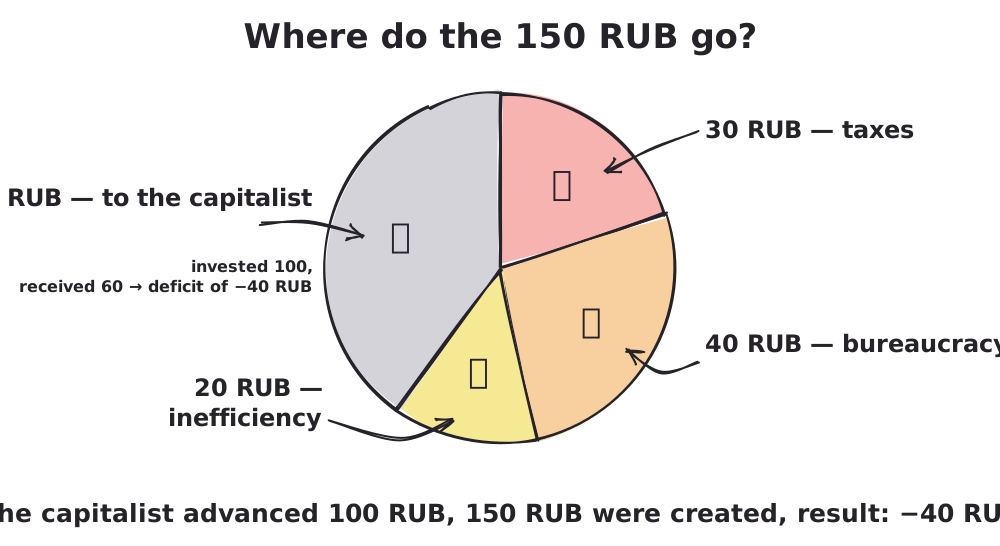
Let us introduce deficit value $u$, the sum of all deficit items; it is negative. In the example $m = 50$ and $u = -90$. By analogy with the rate of surplus value we get the rate of deficit value:
$$u^{\prime} = \frac{u}{m} \times 100\% = \frac{-90}{50} \times 100\% = -180\%$$
That is, for every rouble earned there are 1.8 roubles of deficit.
Of course, the capitalist would not want to work at a loss. On the other hand, the state would not want the enterprise to close, because then stability would be disturbed. This is where the budget intervention $s$ comes to the rescue: the deficit is covered with budget funds. The rate of profit with the deficit and the intervention taken into account:
$$P^{\prime} = \frac{m + u + s}{c+v} \times 100\%$$
Here it is important to understand which rate to choose. Ideally, the capitalist, like the enterprise, should keep their purchasing power but by no means increase it. Let us assume that the inflation target in our economy is 4%. Then a good rate coincides with inflation:
$$P^{\prime} = \frac{m + u + s}{c+v} \times 100\% \approx 4\%$$
In the example this is $\frac{50 - 90 + s}{100} = 4\%$, hence $s = 44$ RUB. The capitalist receives exactly as much as inflation will eat up: real growth is zero.
A question may arise at once: where will the state get the money for such a dubious venture? How will we stimulate enterprises to be loss-making and keep the already loss-making ones alive? Some external force is needed that will feed the loss-making economy from outside.
Redistribution
Enterprises can be stimulated if business is terrorised (sorry, a professional term) burdened with quasi-taxes whenever it deviates from the course towards stability. For example, if the rate of profit is $X > 4\%$, a fine of $2 \cdot (X - 4\%)$ can be imposed, twice the excess, to be on the safe side: the rate drops below the target, but nobody will want to do it again. Another option could be nationalisation followed by re-privatisation into less efficient hands. And in the most general case, an increase in hidden taxes and in bureaucratic and technological costs.
This approach should gradually destroy the most innovative economic agents and keep the level of innovation in the means of production stable.
External feeding
To feed the system with funds the state cannot use monetary means, as this would accelerate inflation. Instead, the state can use the national wealth of a particular economy, for example, oil and gas.
We get the scheme
- Oil and gas companies generate income
- The state withdraws the windfall income into the treasury
- It “burns” part of the funds on “economically inefficient items of expenditure”
- If the oil price falls, it creates a damper from the accumulated funds to support oil and gas enterprises in loss-making periods
In the case of unpredictable economic instability, the ruling class (the bourgeoisie) will be forced to support the state in order to preserve the status quo. Thus, a non-obvious advantage of implementing the theory is the cleansing of the state from big capital in the long run: money flows from the rich to the poor.
Capital outflow
A hard problem will be to hold back the outflow of capital abroad by the richest participants of the “market”. The natural consequence will be a combination of incentives:
- Negative: closed borders, technical difficulties in withdrawing assets, low awareness through blocking and censorship, a low level of financial literacy.
- Positive: units of a “Future Generations Fund”, backed by the oil and gas income of the distant bright future.
- Psychology: “where you were born is where you are needed” as an economic imperative.
The tired man
Why build a rocket if you can endlessly paint the fence around the spaceport?
Under deficit value the motivation for labour changes:
- Imitation of vigorous activity (IVA) is the main product of labour when there is an excess of capital: $m = 0$, but $u < 0$. It creates no value, yet it duly produces deficit (reports, approvals, meetings).
- Negative selection: high qualification becomes dangerous, as it creates the risk of uncontrolled growth of $m$, followed by the fine of $2 \cdot (X - 4\%)$.
- The planning horizon collapses to the cycle “from payday to Friday”.
The one who is rewarded is the one who can masterfully justify why it cannot be done.
The cultural aspect
To hinder social change, a culture of the problem, not of its solution, is maintained:
- creating barriers: queues (even digital ones), re-collecting certificates, mandatory professional development courses that teach nothing;
- solving problems is a duty to the Motherland: they must be solved for the sake of solving, not because they are important, so the unimportant ones are solved first;
- diluting responsibility so that nobody can point out exactly who is to blame for a problem.
There is arguing about taste
The schools of followers of the theory of deficit value differ in their choice of tools and methods:
- The globalist school insists on a systemic approach: launching inefficient reserve currencies, restructuring debt pyramids, uniform global reporting standards that nobody is able to meet.
- The classical school uses a method proven over centuries and insists on developing local conflicts between states as a way of “extinguishing” excess capital. This is perhaps the most scientific part of the whole theory: the Marxist theory of crises already describes how the destruction and devaluation of capital restores the rate of profit.
- The institutional school proposes creating specialised supranational bodies with broad powers (on paper) and vague responsibility.
The joker in the deck (AI)
And what about AI? At first glance the prospect looks alarming: a technology capable of automating intellectual labour threatens to give a push to a new round of development, precisely when it has finally been brought under control. In the terms of our model, AI is the limiting growth of $c$ as $v \to 0$: machines that need no worker. Only living labour creates surplus value, so together with it $m$ disappears too, and $P^{\prime} \to 0$ for good.
The solutions are, in essence, ways to keep AI in the role of deficit rather than of a machine:
- AI slop
- Misalignment
- Agentic chaos
Limitations of the theory
The first limitation is the absence of an explicit closed loop. Stability is maintained solely by oil and gas income, which may one day run out.
The second limitation is coordination. The theory only works globally. If one country slows down while its neighbours grow, capital and people simply leave for where the growth is.
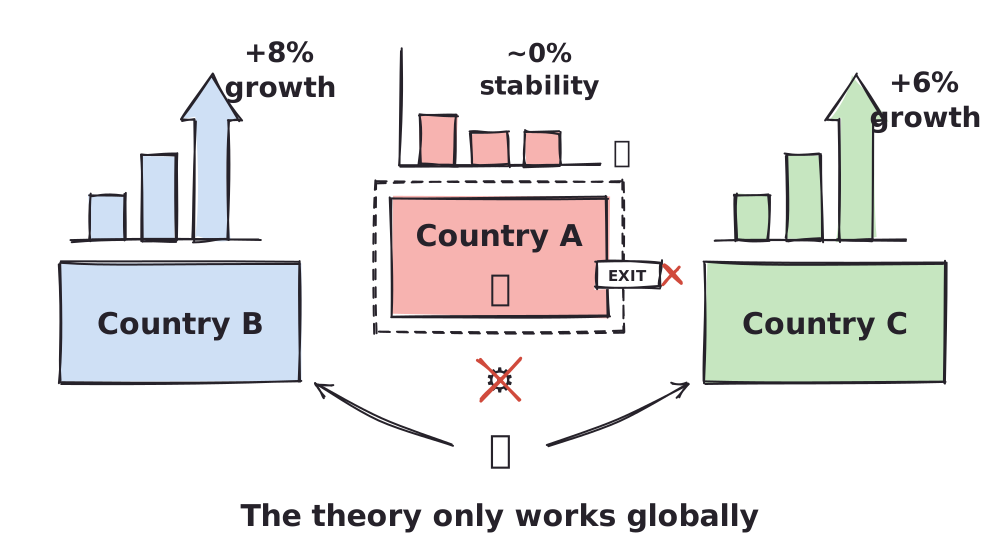
“~0% stability” in the diagrams is the real growth of the economy: with the rate of profit at the level of inflation, it comes out at around zero.
With global coordination, on the other hand, all countries stand at ~0% real growth, and the common budget fund is fed by oil.
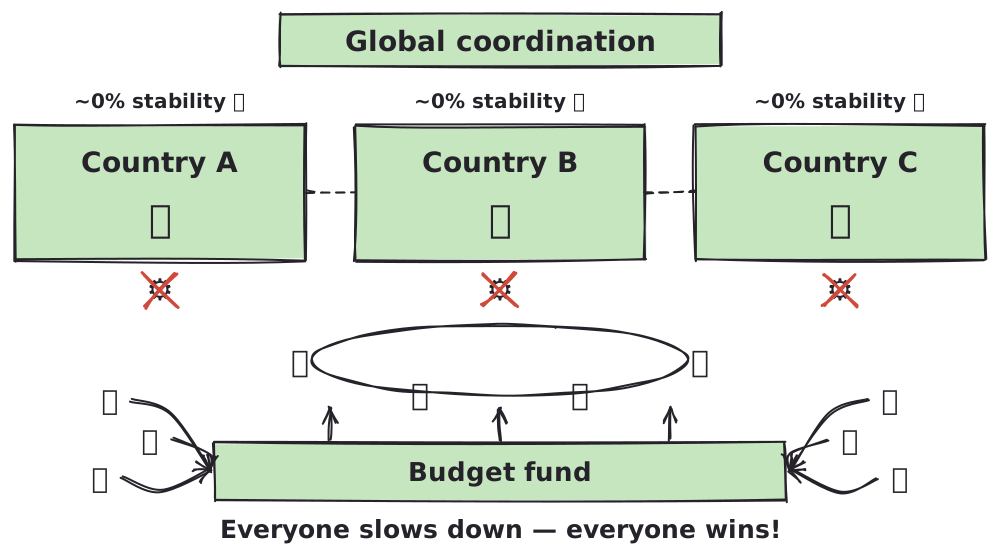
Both limitations come down to one thing: stability holds until either the oil or the neighbours’ patience runs out, that is, the crisis is not prevented but only postponed. Let us introduce the main postulate:
The theory of deficit value does not solve the problem of growth: it converts it into a problem of time.
But since our planning horizon is less than a year, time is not a problem.